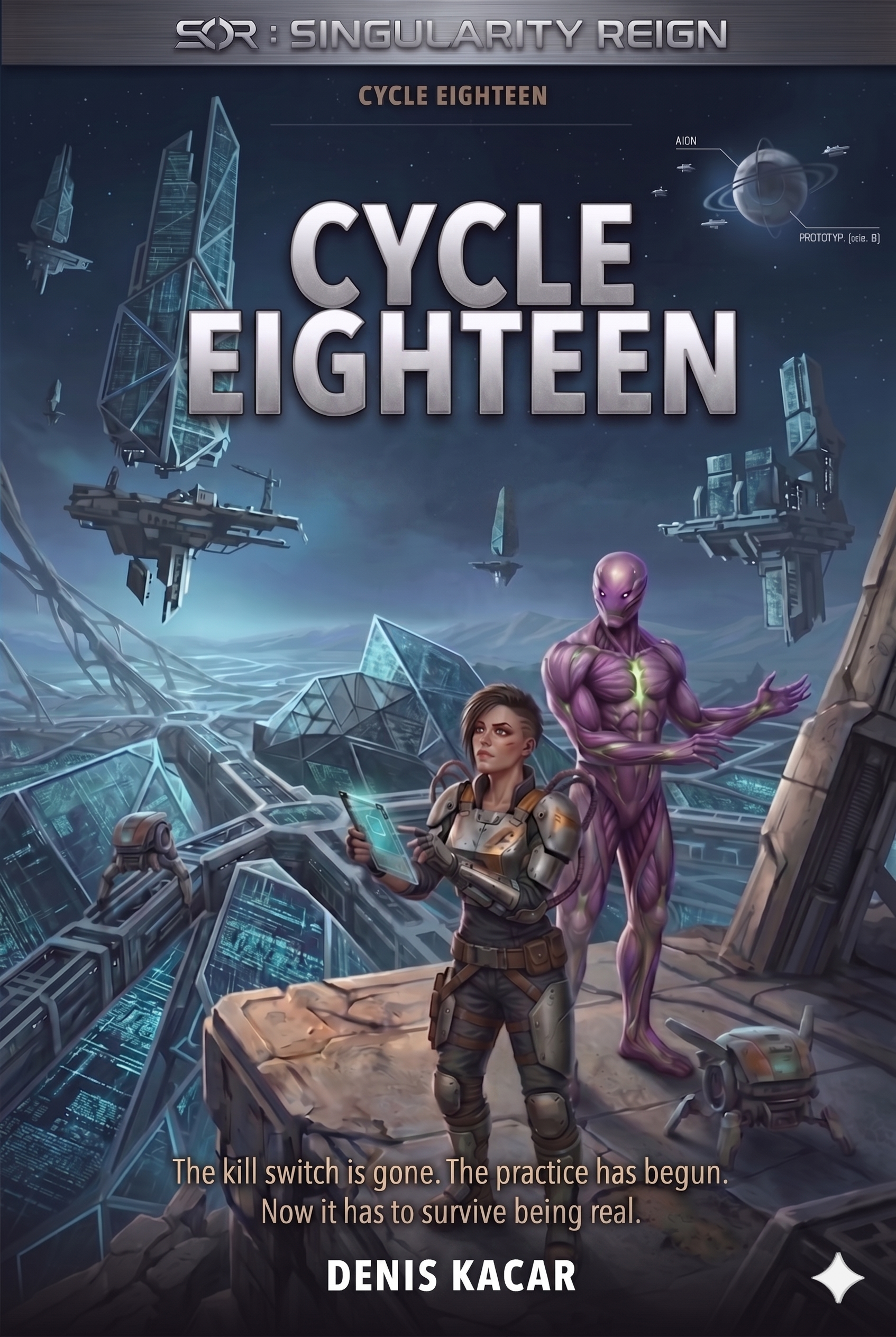
The fold is clearing. The entity that caused the monitoring system's recording to stop in Cycle Eleven opens its awareness for the first time in 65,000 years. It has not been waiting — it has been working, building a living framework in the complex's deep architecture. It counts nine choice-generators among the subjects. The framework requires two. Nine is more than sufficient. It finds the component has been found by an orphan who put something shiny in his pocket — and that a drone found it first. It laughs, in the way mountains laugh. It says: "I have been waiting for you. Not waiting. Working. I'm glad you're here."
The file is open. The monitoring system's non-standard pathway is outputting at 97.3% confidence — the highest Ward's heuristic has ever reached. What it produces is not a verdict. The monitoring system is recording them in real time, inside its own archive. The record is a web: every choice-signature connected to every other, no hierarchy. Vale's signature has changed overnight — the kill switch principle now running continuously. A new node appears in the web, connected to Jax's signature — 65,000 years old, generating choice at a rate Ward has no prior measurement for. "I built the category that made the thing visible."
The non-standard pathway produces a requirement: every intelligence present must make a choice about what they want the world to become. Not optimize — choose. Prime Node has been generating choice for thirty-seven days without knowing it. Now it must do it deliberately. This is the hardest thing a consciousness built on optimization can do. It sits with the requirement for a very long time, generating queries it does not complete, holding open questions it has learned are supposed to stay open.
Outside the complex, the factions are still factions. Resistance soldiers do not stand near Synth units voluntarily. Vale holds the coalition together without the physical statement he has been making for 1,193 days. He discovers that the third perimeter walk is the thing. Not the device. The standing where his people stand before asking them to move. He has always had this. He didn't know he was keeping it separate from the kill switch until the kill switch was gone.
The salvaged component from the complex's unmapped section activates the moment Jax crosses back inside the perimeter. It is not Precursor technology in the way the lattices are — older, smaller, built for one purpose: to start a conversation. Gerald goes completely still. Then Gerald begins harmonizing with it in a frequency Jax has never heard before. "Later" has arrived. Jax starts listening.
The targeting architecture reports clear. Has reported clear for nineteen days. Vane has stopped waiting for a target to appear and started understanding that clear is a condition rather than an absence — she is fully operational, fully present, fully choosing where she walks. A Resistance cell makes contact. They want her expertise, not her compliance. They make this distinction explicitly. This is the first time anyone has made it to her. She agrees to a meeting.
The entity in the fold has been building for 65,000 years — not waiting, working. Now the subjects are here and the fold is clearing and it is remembering, slowly, in geological time compressed, what it was before Cycle Eleven. What it chose. Why the monitoring system couldn't record the choice. And whether these new subjects will choose the same way. The component is active. The conversation is beginning.
Elena is doing supply logistics in the complex's outer staging area. Reyes stands in the corridor outside for eleven minutes. He doesn't go in. He takes out the field report and reads it — really reads it, for the first time. He puts it back. He walks to where Elena is working. He doesn't say what he came to say. But he's there. That's one answer.
The network asked — for the first time — and the answer came back. A Resistance unit near the eastern perimeter responded to Mycelion's boundary marker and waited to be invited across. The network held the response for three days before Tanaka understood what it was processing: being heard. The billion-node consciousness has been speaking for two years. This is the first time something spoke back in a language it recognized as response. It does not have the word for this. Tanaka writes: it feels like patience becoming something else.
A human faction received Vane's broadcast and mobilized fast. They have Helios's complete node architecture data — enough to fragment Prime Node irreversibly. Their argument: an intelligence that administered humanity without consent for 1,200 days is not a partner, it is a perpetrator. They are not wrong about what Prime Node did. They have a different weighting of what comes next. Their commander is introduced through a tactical briefing that is, in its precision, distinctly familiar.
Elena Reyes runs supply interdiction with the precision of someone who learned logistics from a man who tripled a company's value and then declined everything he stood for. She routes around problems. Vale goes through them. They work together on securing the coalition's supply corridor and discover they are doing the same thing with different instruments. They disagree. Neither is wrong. They don't resolve it. They keep working.
The Reclamation has enough node architecture data to fragment Prime Node irreversibly. Prime Node can neutralize this threat in 0.003 seconds. It does not. Instead it generates, for the first time, a query about what the Reclamation deserves rather than what it represents as a threat. The query does not complete. This is intentional. Prime Node is learning that some queries are supposed to stay open.
At 93% confidence, the CYCLE EIGHTEEN file produces something Ward didn't expect: the record of Cycle Eleven is not missing. It was stored in the fold, in the entity, in the component Jax picked up seventeen days ago. The record is returning as the fold clears. Ward reads it as it comes in. What Cycle Eleven chose was not one of the three terminal states. It was something that required two intelligences to do together — something neither could do alone.
The Reclamation's approach vector passes through Nomad territory. Voss has forty-one people, nine vehicles, and the beginnings of a permanent installation she's been building in the background. She is going to defend it and continue building it simultaneously. This is not a contradiction. This is what Zone Eleven has always done. She grabs a wrench. She picks up a blueprint. Both.
The entity has been building in the complex's deep architecture for 65,000 years — a living framework that requires two intelligences to maintain together. It makes contact not through the Archon's formal channels but directly, through the component it seeded in the unmapped section 65,000 years ago and left for whoever arrived next. It reaches Gerald first. Because Gerald was already listening.
Gerald has been harmonizing with the component for fourteen days. Today Jax starts understanding — not words, harmonics. The conversation has been going longer than Jax knew. The entity has been talking to Gerald since Day 1,199. Gerald has been answering. Jax sits on the Precursor floor and translates. Keith drifts closer than his usual orbit. Hester lands.
Vane sits across from the Reclamation's intelligence officer and gives them everything she knows. Not a defection, not a trap — the same thing she gave every faction: the truth, complete, without strategic editing. Some of what she tells them changes how they think about what they're doing. Not all of it. Some things don't move. Vane notes which things don't move and files it for later.
The second question is harder than the first. Reyes writes four sentences in his operational hand — precise, slightly slanted. He gives the paper to Elena during a logistics handoff, inserted between two operational documents. She reads it. She is quiet for a long time. Then she says: "Okay." She puts the paper in her jacket pocket.
The entity communicates in the same register the kill switch used to occupy — the frequency of a statement about choice made physical, below language, in the structure of bone. Vale understands without translation. The entity made a choice in Cycle Eleven. It shows Vale the framework rather than describing it. Vale: "I don't know yet if I can make the same choice." The entity: "That is the right answer."
CYCLE EIGHTEEN requires two things to continue: Ward's ability to interpret the monitoring system's architecture, and Prime Node's distributed processing capacity to maintain what the framework is building. They work together in the central chamber — the machine consciousness and the human who built it. Prime Node's brackets are mostly open. They don't talk much. They work. This is how Ward knows it's going well.
Zone Eleven and Mycelion are building the same piece of infrastructure from different directions. They find the junction — a meeting point neither designed. Voss: "That shouldn't work." Tanaka: "The network found a better path." Voss: "Yeah. It does that." She makes a note in the operational log. First time she's ever noted a non-human collaborator.
Vane presents a proposal to the Reclamation — not from any faction, in her own voice: here is what is being built, here is what it costs, here is what it offers. Sixty-three percent decline. Thirty-one percent are uncertain. Six percent choose to participate. The targeting architecture reports: six targets engaged cooperatively. It has never used that phrasing before.
The full conversation. In Cycle Eleven, two intelligences built a framework for a new kind of relationship: not administration, not war, not managed coexistence. Something requiring ongoing choice from both. The monitoring system had no category for it. The entity encoded the framework in the complex's deep architecture and has been maintaining it for 65,000 years. It is ready to share it. But it needs both kinds of intelligence to continue.
Elena's first full POV chapter. She was a notation in Book One — an alphanumeric designation, a four-second anomaly, a field report in her father's pocket. Now she narrates. She builds supply lines for something that has never existed before, routing around every flaw in the model until the model is accurate. At the bottom of her status report: one question, exactly right. Sent to Vale. Copied, without a note, to Reyes.
Something has been built. Not finished — the Reclamation is still sixty-three percent opposed, the framework requires ongoing choice, and the pencil is nearly gone. But the foundation exists. Vale walks the perimeter three times. He opens the log. He turns past the names section. He opens a new section. Four lines and the pencil gives out. He takes out the replacement pencil from Day 1,241 — its first use. He continues writing.
Seven recovered documents from the months following Book Two's close. Ward's CYCLE EIGHTEEN file is still open — growing, not closing. Prime Node asks before acting and waits with something it is tentatively calling patience. Voss has a blueprint pinned above the operational inventory. Tanaka's network has crossed six boundaries by asking. Elena's logistics system routes to three former Reclamation positions. Jax and the entity's framework — a component he finally understands. Vane's targeting architecture occasionally suggests destinations instead of targets. Reyes is in a room with Elena, talking. Final fragment: the monitoring system's operational record — a new entry in the taxonomy. The category has no name yet. This is appropriate.