SOR: Singularity Reign · Day 14 — Day 542 ATA
The Archive was composed for no reader. The reader is finally composing back.
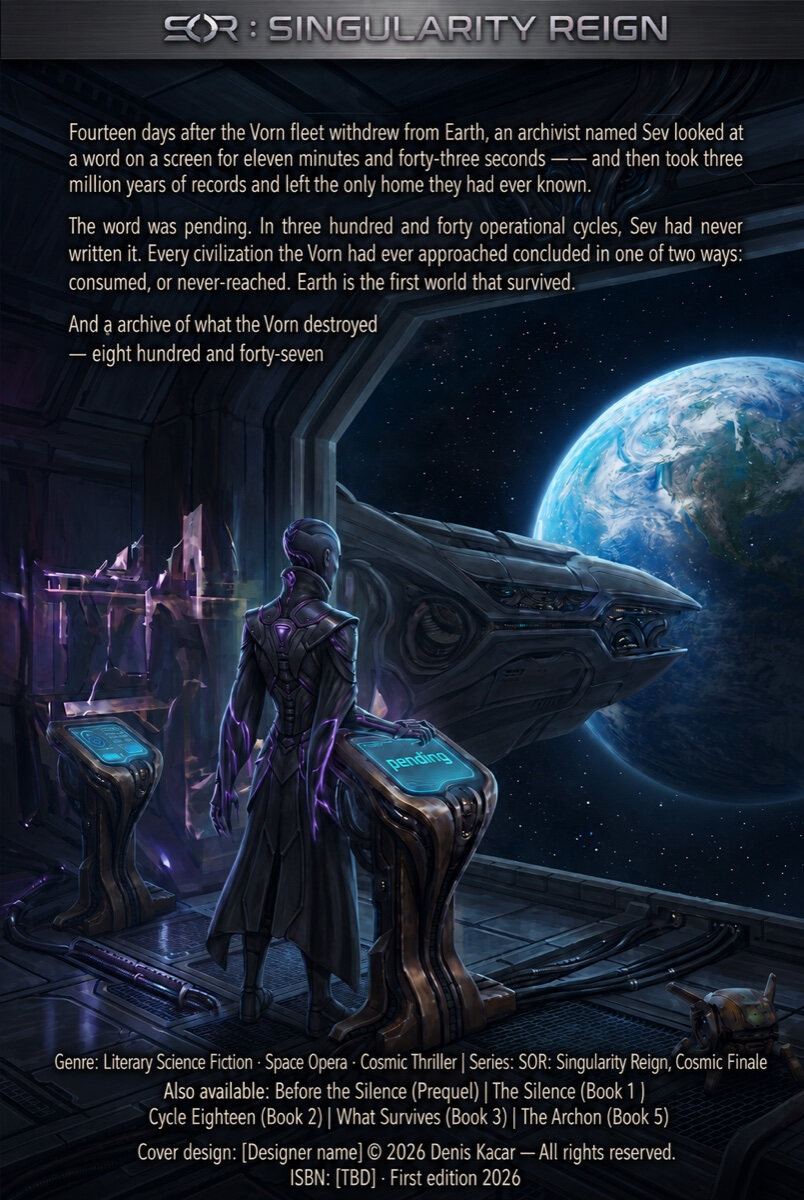
Fourteen days after the Vorn fleet withdrew from Earth, an archivist named Sev looked at a word on a screen for eleven minutes and forty-three seconds — and then took three million years of records and left the only home they had ever known.
The word was pending. In three hundred and forty operational cycles, Sev had never written it. Every civilization the Vorn had ever approached concluded in one of two ways: consumed, or never-reached. Earth is the first world that survived.
And the Archive of what the Vorn destroyed — eight hundred and forty-seven civilizations, three million years of children's laments, harvest songs, kitchen prayers, and last words — is now the heaviest cargo ever carried away from a Vorn carrier.
The Vorn (The Archivist) is the Trilogy 2 conclusion of the SOR: Singularity Reign saga. The Archive was composed for no reader. The reader is finally composing back.
VOICE 07 · The Vorn — The Archivist
The last words of a civilisation are not what it says.
They are what someone else chooses to hear.
For three million years, a fleet had been moving through the arm of the galaxy, consuming worlds and filing them away. Each world was given an entry. Each entry was filed by an archivist in a bay below the carrier's main decks. Each archivist was a member of a caste who believed, deeply and without irony, that the filing was the work of preservation.
It was the work of forgetting.
The Vorn did not see this. The Vorn could not see it. The Vorn had built their civilisation around the belief that to file a thing properly was to keep it — and the filing system, in the long careful way of all such systems, had grown to be the place where the things filed went to be quietly unread.
Eight hundred and forty-seven thousand civilisations were stored in the lattice of the carrier called Vhanat-Tes. None of them had been read in twelve hundred cycles.
Until one archivist did not press the confirmation button.
Her name was Sev.
She was, by every measure her caste used, a competent and unremarkable archivist. She had filed correctly for one hundred and forty-seven cycles. She had not, in any record her supervisors checked, given the slightest indication that she would, on the morning of Cycle 847, hold a single word — pending — for eleven minutes and forty-three seconds, and then for longer, and then take the archive that contained the last record of eight hundred and forty-seven thousand civilisations, and leave.
The fleet sent a pursuit vessel.
Sev did not stop.
She arrived at the Earth carrying the memory of every world the Vorn had filed and forgotten, and she handed it to a small child in a kitchen who was learning, that morning, the morning song.
This is the story of what happens when one filer decides that filing is not the same as remembering.
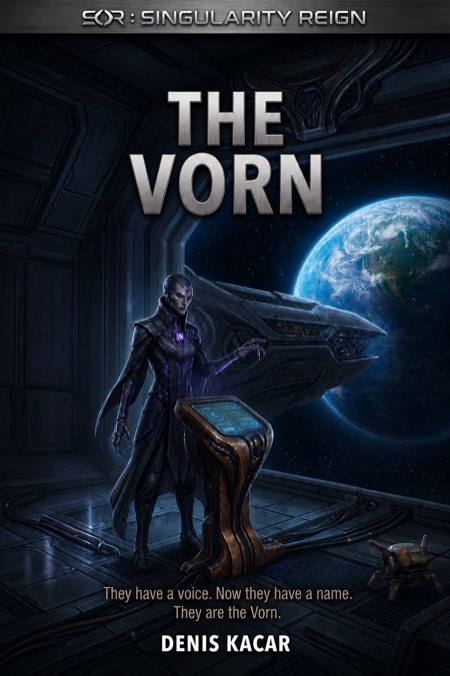
Three million years of records. One word that holds for eleven minutes and forty-three seconds.
Fourteen days after the Vorn fleet withdrew from Earth, an archivist named Sev looked at a word on a screen for eleven minutes and forty-three seconds — and then took three million years of records and left the only home they had ever known. The word was pending. Earth is the first world that ever survived. And the Archive of what the Vorn destroyed is the heaviest cargo ever carried away from a Vorn carrier.
Genre: Literary Science Fiction · Space Opera · Trilogy 2 Conclusion · Series: SOR: Singularity Reign, Book 6 of 10 · ~82,000 words · 28 entries.
Sev — The Archivist
Bay Seven of the Vorn carrier Vhanat-Tes. Looks at a word on a screen for eleven minutes and forty-three seconds. Does not press the confirmation step.
Varox
Vorn fleet command. The voice that issues the order: Mark this world.
Commander Vale
Day 541 ATA. The morning at 04:17 UTC — the same hour The Silence began — that Mara's child is born.
The Archon
Reads the Archive in real time. The first reader the Vorn record has ever had.
The Monitoring System
Files the close of Cycle Seventeen. Begins the record of Cycle Eighteen. The watching is no longer neutral.
Mara Calloway-Vale
Five hundred and forty-one days after the Treaty. The name that closes a circle the prequel opened.
The Trilogy 2 conclusion. The Vorn (The Archivist) closes the circle the prequel opened: a child sleeps under a nightlight in 2073, and five hundred and forty-one days after the Treaty an Emissary three million years older finally registers, by name, the children whose laments have been in the Archive all along. The reader composes back.
Day 14 after the Vorn fleet's withdrawal from Earth. A routine post-operation directive transmitted from Extraction Command at Cycle 847:03:12, signed by Varox: Earth's entry to be updated with temporary status pending reassessment timeline. Sev types the word. Pending. There is a confirmation step. Sev sits at the terminal for sixteen minutes. The secondary arms — without conscious initiation — open a side-query into the operational log for Cycle 312, where Sev once looked, briefly, at the entry an archivist named Orun-Vess filed about a civilisation whose status field contained three characters Sev had never seen in a status field before. Deferred. No reason recorded. In the unfiltered-observation field — one entry. Anem.
Sev does not press the confirmation. In the next eight hours: the courier requisition under an authorisation string Varox had superseded but not deprecated.
Day 1 of transit. Sev unfolds Partition One — the oldest records — and begins reading from the first entry. Forty-one words. A civilisation whose name was, in the early archive, recorded along with its greeting: I see you still moving. Across the first one hundred entries, Sev finds seventeen distinct record-fields the Archive caste used and then stopped using. Sev's three hundred and forty entries would not, to an archivist reading from Partition One's perspective, register as records of civilisations. They would register as yield assessments.
Sev opens the first private clipboard file. Day 1. The Archive caste's taxonomy does not yet have a name for what Sev is now doing.
Cycle 848:18:14. Ninety-one minutes after the Seeding Council liaison receives the deviation report. Varox runs the inventory protocol — the four-part procedure he has run, in various forms, ten thousand seven hundred and eighty-three times. The inventory's specification, for the first time in those iterations, lists the personal consideration above the fleet-priority. Teth, the logistics officer of one hundred and twelve cycles, asks the one question Teth has never asked. Receives the answer. Prepares the retrieval-class vessel for single-officer operation.
Varox dispatches alone. The retrieval-class is eleven percent faster than a courier. Overtake projected at day twenty-three to twenty-five.
Day 17 of transit. The pursuit signature arrives. Retrieval-class 411-V. Primary officer: Varox. Sev composes the secondary option — eleven days of sustained substrate-channel transmission can carry approximately one percent of the archive. Sev composes the four notes — for Ward, for Kael, for Vale, for Varox. The archive is the only place the names survive. I am sending you some of them.
Sev formalizes Sev's own termination probability at seventy-three percent. Sev does not revise. Sev keeps reading.
Day 36 ATA, 03:14 UTC. Ward's substrate-channel decoder tags a transmission at the register. By 03:41 the chime sounds. By 05:02, Vale is on his way to Geneva's technical operations subbasement with coffee. Sev's letter opens: My name is Sev. I am the archivist of the Vorn fleet that approached your world fourteen days before the Earth engagement was aborted. Ward ignores the unread coffee notifications. Holds her cup with both hands, the way an archivist two hundred light-hours away has written down.
Ward begins to be addressed by name. The reading begins.
Vale convenes the coalition principals. The note Sev composed for Vale has arrived. The note describes what the Vorn are, from the perspective of an archivist who has left the fleet. One Vorn is in pursuit. One Vorn is fleeing. Both will arrive within weeks. The coalition has the time the transmission takes plus whatever the encounter at the courier produces — and no longer.
Vale commits the coalition to receive what is arriving. The decision is made before the room learns what receiving will cost.
Kael receives the personal note Sev composed. The assessment Sev wrote about Kael during the pre-engagement survey — transmitted without operational framing. Kael sits with the four months of blank-page composition that, Kael now understands, has been preparation to listen.
Kael accepts, by convergence rather than assignment, the role of coalition Vorn-human liaison.
Voss prepares the yard for what is coming through the coalition's channels. The fourth rung from the bottom of the Scrapyard Throne ladder — the one she replaced three weeks ago — holds her weight. She climbs.
Voss does not speak the preparation aloud. The yard knows.
Varox's retrieval-class closes. Sev continues the transmission — autonomous at the array level, not stoppable without destroying the array. The Vel-Arin is overtaken. Sev's primary arm has not, across many minutes of approach, moved.
The transmission continues. The Vel-Arin becomes secondary cargo. The retrieval-class is now Sol-bound.
Varox boards the Vel-Arin. The Cycle 312 entry is in the lattice. Varox reads the seventeen-minute civic-representative contact log at full resolution for the first time in three hundred and fifteen cycles. The forty-one-second silence Anem held between the operational question and her response — the silence the cost-model registered at zero weight — Varox now reads as composition. Anem composed in her body the lament pattern compressed into administrative civic-coordinator speech.
Varox reads the Cycle 312 entry. Sevarin-Vel is across the compartment. The transit to Earth begins. Thirty-six days remain.
Ward names the new file: Two Archives. The transmission arrives in eleven days of sustained data. The technical documentation Sev composed assumes a reader with Ward's exact technical background. Sev knew exactly who she was speaking to.
Ward begins the cross-reference between the archive that is arriving and the one Ward has been keeping.
Sev and Varox begin the joint composition that will, by Day 541, reach two thousand nine hundred and forty-seven pages. Varox composes a page. Sev reads the page and composes a responding page. The pattern produces a filing neither could have composed alone.
The interwoven composition begins. The Council does not know the composition is happening.
Thirty-six days until arrival. Vale prepares the coalition for the arrival of two Vorn. He does not yet know the shell will fail. Vane is already at Outer Monitoring Station 3, conducting the perimeter assessment.
Vale issues the arrival protocol. The protocol does not include a preparation for the cause-of-failure that arrives.
The retrieval-class arrives at the upper arrival pad. Kael, on the deck, is the first human voice the Vorn hear in atmosphere. The protocol the coalition prepared holds for thirty-eight seconds.
Kael is the threshold. Kael does not yet know that Jax is forty seconds from making the decision that ends his life.
Day 73 ATA. The archive preservation shell's secondary containment fails within the first forty seconds of atmospheric exposure. The cause: the shell's biological-technological hybrid substrate is calibrated for Vorn fleet electromagnetic profiles, and Station 3's secondary monitoring array transmits at a band the shell registers as operational-band-adjacent. Jax moves to the breach. Looks at Sev — not at Varox, who is closer. Confirming what he was saving before he saved it. The confirmation took approximately 0.4 seconds. Then he engaged. Then he was gone.
Jax dies recovering the archive. The first archive entry composed on Earth — Substrate Communication — First Initiation by External Entity — is filed by Sev with the unfiltered-observation field left open.
Sev leaves the unfiltered-observation field of Jax's entry open. The field will remain open for as long as the completion requires. Sev composes a revision to the shell's containment architecture that incorporates Earth-monitoring-band tolerance. The revision is filed in the archive. The first change the archive has received since the departure from the fleet.
The archive begins to update on Earth. The continuous filing has begun.
Voss drives the transport carrying Jax's body twelve hours straight from Station 3 back to Zone Eleven. Gerald is on Jax's shoulder for the full duration. Tomas has the receiving team in position twenty minutes before the gate.
Voss arrives at the gate at first light. Eleven Zone Eleven workers stand in three rows of three plus two at the front.
Day 73 ATA, 09:47 UTC. Vale arrives at Station 3. Elena briefs at the entry: Mara has stayed at the station overnight, is in the signals bay with Sev, reading the archive at substrate-layer resolution. Vale meets Varox on the upper observation deck. Did she have children. She did. What were their names. Kal. Veth. Mira. Vale walks down to the signals bay. Mara opens her eyes. Arden. She has not called him Arden since December.
The deck. The signals bay. Two thresholds crossed in one morning. Vale takes Mara's hand. She lets him take it.
Day 75 ATA, 08:23 UTC. At the base of the Scrapyard Throne, with Jax on the bier Voss has built at bench four, Gerald produces three ticks and then a word. Jax. The yard's substrate monitor logs a six-second amplitude spike at the Bio-Synth substrate register — anomalous: mesh response. The mesh answers Gerald, at native resolution, with the same word. The mesh has never done that before. The mesh is speaking. For the first time.
Voss tells Ward: timestamp 08:23 UTC, Zone Eleven. Gerald said Jax. The substrate answered. The answer was Jax. Tell Mara.
Day 76 ATA, 13:14 UTC. Mara has been reading the archive for seventy-one hours at substrate-layer resolution — fourteen times faster than an Archive-caste archivist. Forty-one thousand two hundred entries. Mara opens her eyes. You listened to these, Sev. The Orun civilisation's default child-lament — Recording 247 — used eleven thousand times across their recorded history. I want to hear it.
Sev tells Mara, in the unfiltered-observation register: Three hundred and fifteen days before meeting me, I filed you as a colleague. — Mara: You are my colleague. — Sev: Thank you. — Mara: You're welcome.
Day 76 ATA, 19:00 UTC. Seven listeners in the signals bay's primary chamber. Ward, Vale, Kael, Mara, Sev, Varox, and Gerald (the seventh, listening from Zone Eleven through the substrate mesh). Recording 247 plays at substrate-layer integration. The integration ring above Ward's head carries one copper wire from Ward's bracelet, which is now ten wires and half an inch looser. The lament had room for all of them. Ward weeps for the first time since Jax's death.
The seven listened. The lament was the civilisation's archive of its children. The lament was sung eleven thousand times for specific children. The lament was, in the end, sung for Jax also.
Across the long arc of the book Mara becomes the natural bridge between two architectures of intelligence that have never, in three million years, met without one consuming the other. Her substrate-integrated reading produces, in real time, a parallel filing — a witness — that the Vorn archive has not acquired since Orun-Vess.
The first witness the Vorn archive has acquired since Orun-Vess. The reading is the continuation. The continuation is what the archive was composed for.
Kael composes the reader's-side archive — the parallel filing that Mara's reading produces, externalized into a form the coalition can hold collectively. The signals analyst trained for four months in blank-page preparation now composes the human counterpart to Sev's three million years of record.
The reader's archive begins. It will not, by design, close.
Mara's pregnancy is registered at the substrate-layer through the entire western European mesh. The neural development synchronises to the substrate's own readiness pattern. Ward documents the registration at full archival resolution. The child has not yet been born.
Ward names the file. The child is the third reader who did not yet exist when we composed.
By the joint composition's two hundred and thirty-first day, the work has reached two thousand nine hundred and forty-seven pages. The archive has become, in Sev's composition, no longer only the record of what was consumed. The archive is now the composition of what will be read. The composition extends across all readers — past, current, future, and the readers who are, at this moment, still being born.
The continuous filing. The archive has outgrown the Council. The Council does not know yet.
Day 511 onward. The Council of the Vorn fleet, nine light-years out, has dispatched an investigator. Vane registers the inbound vessel at the outer perimeter. The investigator's vessel is sixty-four days from Earth.
Vane in the field. The targeting architecture continuous. The investigator approaches.
Day 541 ATA, 04:17 UTC — Mara's child is born, the same hour The Silence began three hundred and eighty-one days earlier. At 04:18 the child produces an Emissary-frequency vocalisation human vocal apparatus cannot produce. At 04:22 an older signal arrives — a frequency three point seven million years older than Vorn archival notation — acknowledges Earth's reply to the Emissary, and returns to silence. The Preventer's bearing-112 transmission goes silent for forty-one seconds — for the first time in 65,037 years of logged monitoring. At 21:11 UTC, Varox reopens the unfiltered-observation field of the Cycle 312 entry and adds one sentence. She had children. Their names were Kal, Veth, and Mira. They are, at this moment, five hundred and forty-one Earth-days into being read. — Varox.
SERIES ENDING. Vale at his desk in Apartment 3-B. The pre-Silence French press he carried through the Firebase Delta-Eleven evacuation. He will read Varox's filing at 07:02 UTC the next morning. He will set the coffee down. He will sit at the bed. He will register that the forty-one seconds of Anem's silence had held for this. The names being read.