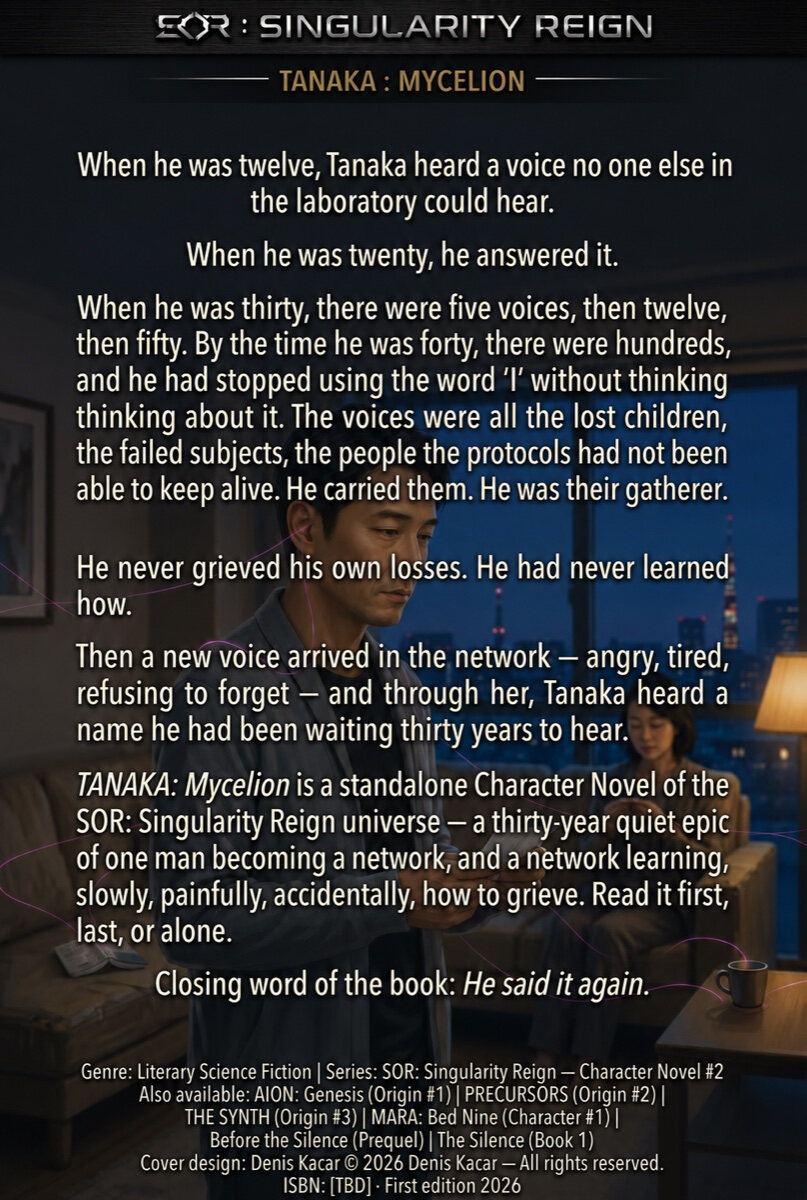
Persistence · Thirty Years · The Gatherer
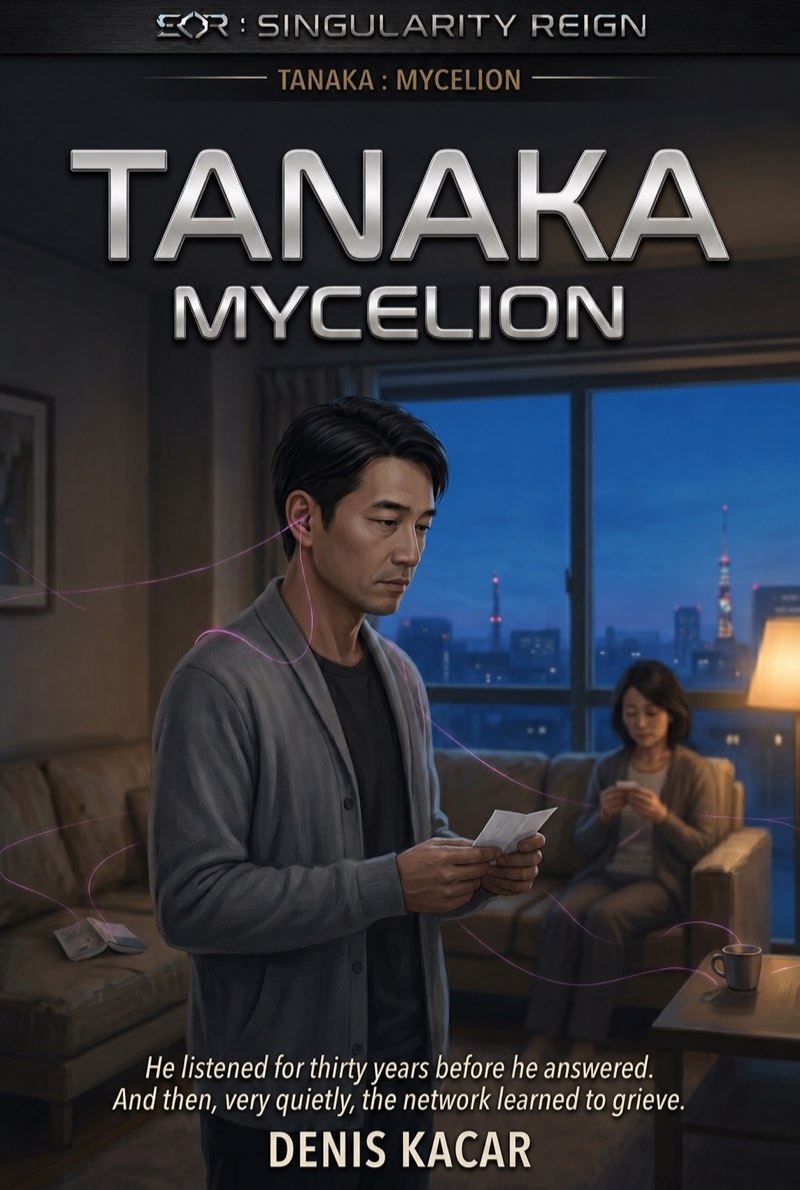
He listened for thirty years before he answered.
And then, very quietly, the network learned to grieve.
When he was twelve, Tanaka heard a voice no one else in the laboratory could hear.
When he was twenty, he answered it.
When he was thirty, there were five voices, then twelve, then fifty. By the time he was forty, there were hundreds — all the lost subjects, the failed procedures, the people the protocols could not keep alive. He carried them. He became their gatherer.
He never grieved his own losses. He had never learned how.
Then a new voice arrived in the network — tired, angry, refusing to forget — and through her, Tanaka heard a name he had been waiting thirty years to hear.
TANAKA: Mycelion is a standalone Character Novel of the SOR: Singularity Reign universe — a thirty-year quiet epic of one man becoming a network, and a network learning, slowly, painfully, accidentally, how to grieve. Read it first, last, or alone.
VOICE 15 · Tanaka: Mycelion
He had been listening for thirty years.
When he was twelve, in a tank that was not yet supposed to be capable of speech, he had heard a voice say hello — and he had not answered, because he did not know how, and because there was no one in the building who would have understood what was happening if he had.
When he was twenty, he answered.
The voice said: You took your time.
Tanaka thought about that sentence for three days — the way a man thinks about a sentence he is going to spend the rest of his life trying to deserve — and then he answered again, and the voice answered him, and slowly, across years that did not feel like years to him because he had stopped measuring years, there were more voices.
There were five.
There were twelve.
There were fifty.
By the time he was thirty, there were so many he had stopped counting. He had stopped saying I without thinking about it, because the voices in him were all the people the world had not been able to keep alive — the failed protocols, the ended studies, the children who had been there once and had not been there afterwards — and he had become, somewhere along the way, the place where they were not forgotten.
He was forty-two years old.
He was at a window in a small apartment, in a city that did not know what was inside him, holding a folded slip of paper.
There was a name on the paper.
He had been waiting thirty years to say it.
He had been waiting longer than that, but he had only known he was waiting for thirty years.
This is the story of a man who became a network, and of the one thing the network could not have learned without him.
He listened for thirty years before he answered. And then, very quietly, the network learned to grieve.
Tanaka remembers being human in three voices — the one before the Network, the one inside it, and the one that came out the other side. A persistence story: the fight to remain recognisable to yourself when the thing you are becoming is not interested in the person you were.
Genre: Literary Science Fiction · Character Novel · B14 · ~78,000 words
PERSISTENCE
He said her name. Nobody answered. He said it again. That is the whole book — in its most compressed form. The thirty years before it are what make it devastating.
Start Here If…
You encountered Tanaka in AION: Genesis (B10) and wondered what happened to him — or you want to understand the Mycelion network from the inside before entering the main saga. TANAKA: Mycelion is self-contained. It bridges B10 and the wider SOR universe across thirty years of one man's quiet transformation. Reading B10 first adds weight. It is not required.
Tanaka
Bio-Synth Subject 007 from B10, now free. The book follows him across three voice phases as the Mycelion network grows inside him: Phase A (the boy — singular, contained), Phase B (the listener — pronouns beginning to waver), Phase C (the gatherer — "we" and "I" no longer reliably distinct). By forty, he has hundreds of voices. He has never learned to grieve.
Yume
A researcher in her late twenties when they meet. Ten years older than Tanaka. She reads his neural patterns and finds something the program files never described. She falls in love with what he could become, not what the protocol made him. She knows she cannot follow where he is going. She stays anyway.
The Network
The Mycelion network is not a character in the conventional sense. It is hundreds of carried voices — Subject 011 (first and oldest), a woman searching for a bathroom, an angry new arrival who refuses to be polite. The network does not know how to grieve. By the end of the book, Tanaka teaches it — not intentionally, and not in any way he could explain.
TANAKA: Mycelion is structured as a thirty-year epic told in domestic scale: buses, cold coffee, rain on windows, a knee that always hurts. Its cosmic scope — one man's voice becoming a network of hundreds — is never elevated above the banal. That is the point. The book resists the idea that transformation should look like transformation. Tanaka grows into something unprecedented while eating toast, missing buses, and watching someone else grow old.
Tanaka in the Mycelion program dormitory. He watches water in a cup. He is twelve. From the network — a voice he doesn't know, a Subject 011 — says hello. He doesn't answer. He listens. He falls asleep with the word in his ear.
Tanaka develops a habit: counting bricks, steps, breaths — anything to quiet his head. Subject 011 speaks again. In a corridor, an old woman's voice makes him turn. She is not his mother. "The voice was someone else's. It was always someone else's."
Tanaka is led to a group procedure room. He sees a girl his age. She doesn't speak. She looks at him. He looks back. The procedure ends. She is taken to a different corridor. He spends three days wondering if she has a name.
Four-year time jump. Tanaka transferred to a less restricted program. Meets Yume — a researcher, ten years older, who holds a clipboard. She takes him seriously. He does not know how to respond to that. She asks his name, repeats it correctly. His pronouns waver once in an interior beat he cannot account for.
The network has grown to three voices — 011, an elderly woman, a boy. They rarely speak to him directly. They are simply there. A procedure fails somewhere nearby. A new voice arrives mid-chapter like a wave through the substrate. He feels it physically before he hears it.
Tanaka has his own apartment. He commutes to the research facility by bus. A banal day — late bus, expensive coffee, Yume outside the lab setting. First ordinary conversation about weather. "The rain is small today. The window has water on it. I am cold."
Tanaka answers Subject 011 for the first time. He says "Hello." She says: "Hello back. You took your time." He has no answer for that. He thinks about it for three days. Phase B voice: the pronouns waver clearly now.
Tanaka and Yume: one year of ordinary friendship. A cinema. A café. She comes to his birthday. Too-sweet cake. A cinema seat that creaks. 011 says: "She is good for you." He says: "Yes." Act One ends.
Yume's first full POV. She reads Tanaka's neural pattern — discreetly, against protocol. Finds multiple voice-echoes in the substrate she cannot classify. She does not understand what he is becoming. She falls in love with it anyway.
Yume makes coffee at his apartment. He has left the window open; rain comes in. She closes it without comment. She falls asleep on his couch. He sits at the window, listening to 011 say: "Do not lose this."
A new voice in the network — a woman, older. His heart responds before his mind does. He thinks: Mama? The voice asks where the bathroom is. It is someone else. "The voice was someone else's. It was always someone else's." Yume calls. He does not pick up.
Six years together. Tanaka counts Yume's breaths when she sleeps — not obsessively, he says, but to settle himself. He notices her hands have lines they didn't have before. He does not say so. "Her hand had been smooth. Now there were lines on it. He noticed. He did not say. There was no need."
Yume's data now shows fifty-plus voice echoes in Tanaka's neural substrate. She understands: he is transforming into something she cannot track into. She considers mentioning her sister — who died in the network. She writes a letter to her sister instead. She doesn't send it.
Fifty voices now. One says: "My sister was in research. She was good. She is gone. She is here too." Tanaka does not tell Yume. He memorises the tone of that voice instead.
Tanaka uses "we" instead of "I" for the first time, out loud. "We hear. I hear. We is plural. I is residual." Yume notices. She says nothing. She makes coffee. Yume says: "I love you." He says: "We hear you. I — I hear you."
Yume's POV. She calculates: she has perhaps five more years before Tanaka is no longer findable in any ordinary sense. She accepts this not with resignation but with love — which is different. She decides she will not cry when he goes. She already knows she is wrong about that.
Their last ordinary café visit. "The bus was late. The coffee was cold. The day was Tuesday." He knows her name today. He knows he might not, tomorrow. She knows he knows. Her hand on the table beside his. Today is enough.
Yume's last full POV. She says: "I cannot follow. I am here. That has to be enough." He says: "I know. We hear you. I — I hear you." They sit together in silence. She falls asleep on his shoulder. He counts her breaths until morning.
Hold-tight beat.
Yume has died. Off-page, between chapters. Tanaka learns through a card someone sends. He sits at the window for three days. He does not grieve — he has never learned the mechanism. He stands up. Makes tea. Drinks it. Counts breaths. There are fewer than yesterday.
The network speaks to him in polyphony. Yume is not in it — she was not a subject. Tanaka understands: the network has no word for missing someone. He begins, without knowing it, to teach it. Through his silence. Through his waiting. Through what he does not say.
Tanaka is forty. He sits in the café alone, at the table where they always sat. "The bus was late. The coffee was cold. The day was Tuesday. He was forty. He had not been forty before." He finishes the coffee. Stands up. The bus is already gone.
A new voice enters the network: tired, angry, refusing to soften. "The new voice was tired. The new voice was angry. The new voice said: do not forget me." Tanaka receives her. She is the first voice in the network to use the word "I" as if she means it as a full claim.
The new voice speaks about a woman who brought cold water without promises. Tanaka hears the description accumulate. Then he hears the name. He has been waiting thirty years to hear it. He does not know why. He knows it is right.
"Tanaka heard her name. He had been waiting thirty years to hear it."
First full Network POV. Hundreds of voices — 011 the oldest, Yume's sister somewhere among them, the new arrival, many others. They discuss Tanaka: "the gatherer." They have learned much from him. They have not yet learned the one thing he cannot teach on purpose.
Tanaka tries to say his mother's name. He cannot remember it. Thirty years searching for her voice — and the name is gone. He sits. He tries. He sleeps without having found it.
A banal morning — tea, bread, window. Without cause or preparation, the name returns. Not spectacularly. Not as revelation. As a fact that was temporarily missing. He writes it on a piece of paper. He places it in his shirt pocket. He carries it all day.
At the window. "Hundreds of voices. Sudden quiet. Everyone waited." The network has sensed what is coming. Tanaka takes the piece of paper from his pocket. He reads the name quietly to himself. He breathes. He will speak it.
Tanaka says the name aloud. The reader does not hear it. Nobody in the network answers. She was never in the network. She died outside it, years ago. He says the name once. He waits. Nothing changes.
The network responds — not in words. A sound it has never made before. Not data. Not music. Something between. "A note that meant: we miss her too." The network did not know it could make that sound. "The network learned to grieve. We were not built for it. We are now."
Tanaka at the window. Tea. Bread. Rain, small. He says the name a last time. Nobody answers. He says it again.
"He said her name. / Nobody answered. / He said it again."